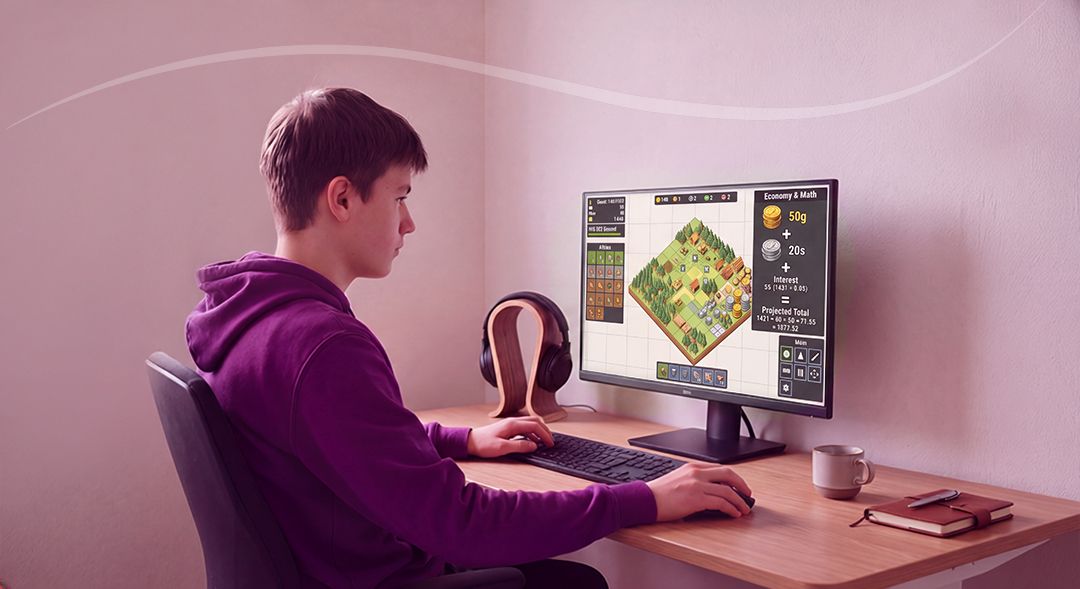
Your Child’s Video Game Habit May Be Building Math Skills
Did you know that your child might be using math while gaming without even realising it?
A player may calculate how many resources they need in Minecraft, compare character statistics in Pokémon or decide whether they have enough points for an upgrade. They may not be sitting in front of a worksheet, but they are still estimating, comparing, calculating and planning. Mathnasium highlights how popular games can include mathematical ideas such as geometry, probability, percentages and resource management. This raises an interesting question: Could gaming help children practise math in a way that feels completely natural?
Math Is Hidden Inside Many Games
Math does not always appear as an equation. In strategy, building and role-playing games, players often work with numbers and patterns as part of reaching a goal. For example, Minecraft can involve spatial planning, 3D visualisation and resource calculations, while Pokémon encourages players to compare statistics, probabilities and multipliers. The difference is that these calculations have an immediate purpose. Players use math because it helps them succeed in the game.
Gaming Turns Problems Into Challenges
Games constantly ask players to make decisions. A strategy may fail, so the player changes something and tries again. This encourages problem-solving, logical thinking, pattern recognition and persistence. Games also provide immediate feedback. Players quickly discover whether their strategy worked and can adjust their approach. Instead of thinking: “I got the answer wrong.” The player is more likely to think: “That didn’t work. What should I try next?” That mindset can also be valuable when learning mathematics.
Games Can Make Math Feel More Practical
Mathematical ideas can sometimes feel abstract in a classroom. Games can give those same ideas a practical purpose. A percentage might represent the chance of an attack succeeding. Geometry might help a player build a structure. Statistics might help them decide between two characters. Research into game-based mathematics learning has found generally positive effects on learning outcomes, although results depend on the type of game and how it is used. This does not mean every video game automatically teaches mathematics. But gaming can create opportunities to use mathematical thinking in meaningful situations.
Parents Can Look Beyond Screen Time
When parents see their child gaming, it can be easy to focus only on the amount of time spent on the screen. But a child may also be planning, calculating, experimenting and solving problems. Parents can even ask simple questions such as: “How did you know how many resources you needed?” or “How did you decide which option was better?” These conversations can reveal the thinking happening behind the game.
Gaming and Learning Can Work Together
Gaming should not replace school, sleep, physical activity or time with family and friends. But it does not always have to compete with learning either. At Game Limiter, we believe healthy gaming is about finding the right balance. Clear boundaries can give children space to enjoy the positive side of gaming while protecting time for other important parts of life. Instead of asking only: “How long has my child been gaming?” We can also ask: “What are they thinking and learning while they play?” Because sometimes the child building a Minecraft world or planning the perfect strategy may be using more mathematical thinking than we realise. Gaming and learning do not have to be opposites. With the right balance, they can work together.
Read the full study here